


Neuropsychological Assessment of Dyscalculia: Understanding Difficulties with Mathematics
Does your child still count on their fingers for simple addition problems, forget their multiplication tables from one week to the next, and dread every math assignment? At CERC, a neuropsychological evaluation for dyscalculia (or a learning disability involving difficulties with math) helps identify the root cause of these challenges and determine the next steps. Since 2003, our neuropsychologists have been welcoming families with an open ear and a nonjudgmental attitude.
Dyscalculia: A Learning Disability in Mathematics
This disorder affects number sense, the memorization of arithmetic facts, and calculation. Its official name is specific learning disorder with a deficit in calculation. It has a neurodevelopmental origin and is estimated to affect 3 to 8 percent of children, depending on the diagnostic criteria used.
Much more than just a delay
A delay in math can be overcome with extra help. Dyscalculia, however, persists, even if its manifestations change with age: counting improves, but then mental math or estimation become the challenge. This often stems from a fundamental lack of understanding of various concepts involving numbers, such as estimating the time it takes to travel a distance, comparing orders of magnitude in context (200 children in a classroom vs. 200 children in an NHL arena), understanding the logic of multiplication (which is repeated addition), understanding the logic of division (equal distribution into subsets), etc.
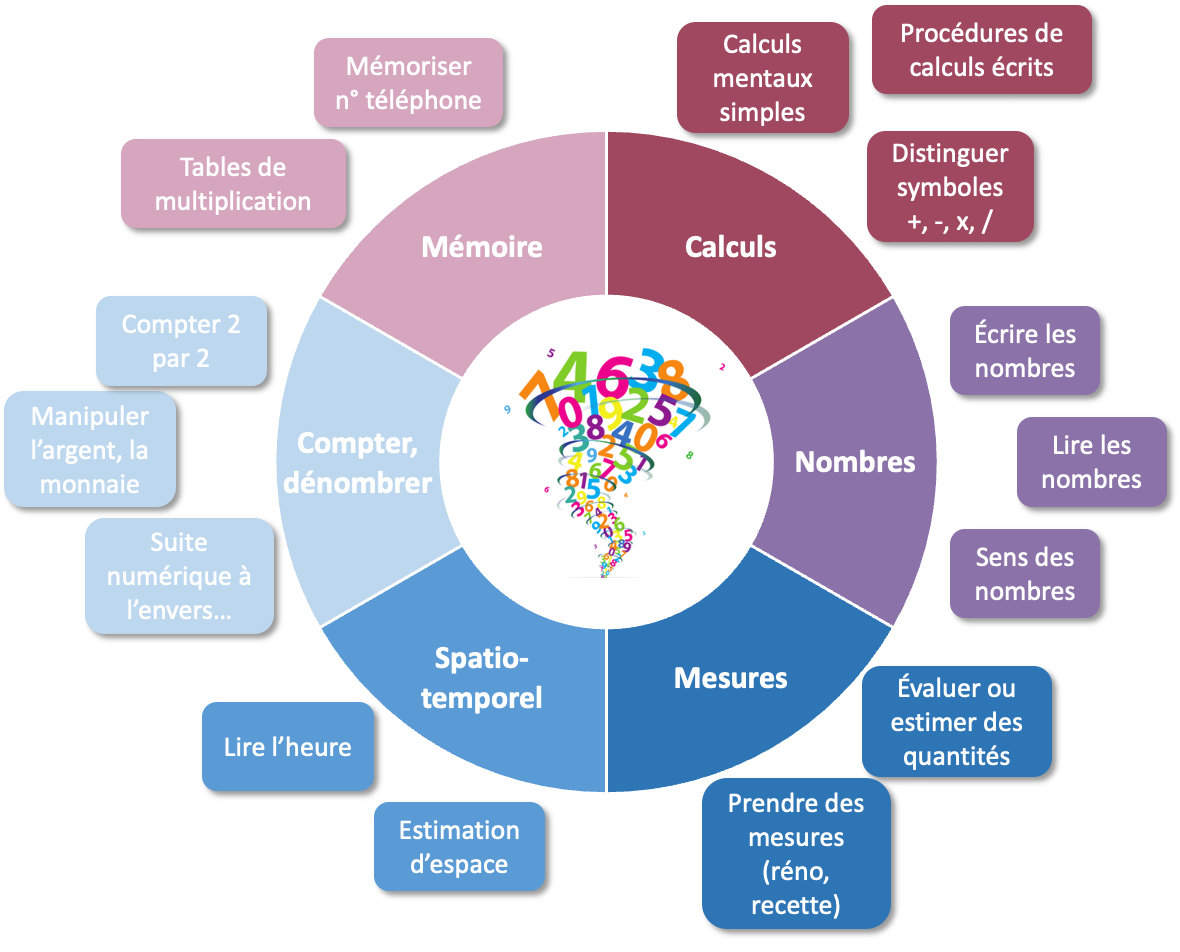
The following chart clearly illustrates the various areas that may be affected by dyscalculia:
Warning Signs to Watch For
You should seek help when a child is struggling with math far more than other children, without achieving commensurate results. There are several warning signs:
- Mistakes when counting objects or reciting the counting rhyme;
- Addition or multiplication tables that don't become second nature;
- Numbers that are misread or misspelled, such as “1002” for “one hundred two”;
- Difficulty comparing numbers or estimating the result of a calculation;
- Word problems in which the child doesn't know which operation to choose;
- A tendency to avoid—or even feel anxious about—anything related to numbers.
These difficulties may also be related to other disorders. Our page onthe assessment of learning disabilities also discusses dyslexia and dysorthography.
Who diagnoses dyscalculia?
The diagnosis of dyscalculia is made by a neuropsychologist who is a member of the Ordre des psychologues du Québec. The teacher or special education teacher at the school often identifies the initial difficulties. However, only a neuropsychological evaluation can determine whether these difficulties stem from dyscalculia or another cause.
Dyscalculia in Adults
This diagnosis can be made in adulthood, even if the difficulties date back to childhood. Many people went through school without being able to put their relationship with numbers into words. In college or university, an up-to-date diagnosis provides access to accommodations: extra time on exams, assistive software, and a lighter course load. Our neuropsychological assessment for adults takes place over a full day.
Our Dyscalculia Assessment Process
The assessment compares math skills to intellectual ability, age, and educational background. It consists of four parts.
Initial Medical History and School Observations
During a one-hour session—often conducted remotely—the neuropsychologist reviews the child’s development, academic history, and the observations provided by the school.
Mathematics and Cognitive Function Tests
The tests take place over the course of a full day or two half-days, for a total of 5 to 6 hours. Among other things, the neuropsychologist assesses:
- Number sense and counting;
- Calculation and arithmetic facts;
- Problem-solving;
- Working Memory and Attention;
- Intellectual potential.
Accurate Differential Diagnosis
The neuropsychologist analyzes the nature of the errors and checks for associated disorders, such as ADHD or dyslexia. He or she also distinguishes dyscalculia from difficulties related to anxiety or a concept that was not taught properly.
Review meeting and concrete recommendations
About three to four weeks after the evaluation, the report and its recommendations are explained to you during a meeting. The report guides remedial education and accommodations at school, such as the use of a calculator or extra time. The school decides how to implement these measures, often as part of the student’s intervention plan.
Why should you trust the CERC team?
Since 2003, the CERC has established itself as a leading authority in neuropsychology for children, adolescents, and adults in Quebec.
More than 23 years of expertise in learning disabilities
Our neuropsychologists work closely with our special education teachers, ensuring continuity between diagnosis and rehabilitation. Our special education teachers also develop problem-solving tools for use in the classroom and at home.
Institutional partnerships and rigorous evaluation
For the review of case studies and continuing education, we collaborate with the Ordre des psychologues du Québec and the Association québécoise des neuropsychologues. Every test we use is standardized and recognized.
Three clinics and an online option
Our clinics are located in Ville Mont-Royal, Laval (Boulevard du Souvenir), and Brossard (Avenue Auteuil). We also welcome families from the North Shore and the Montérégie region. For those in remote areas, a remote assessment is available.
A caring, family-centered approach
We place respect, empathy, and active listening at the heart of our practice. Our goal: to empower parents—without judgment—as they navigate academic challenges.
Ready to better understand your child's challenges with math? Contact the CERC team to schedule a neuropsychological evaluation.
To schedule an appointment or for any questions regarding dyscalculia
Our neuropsychologists
Our evaluations are conducted by neuropsychologists who are members of the Ordre des psychologues du Québec, and follow-ups are handled by our special education teachers.


